Table of Contents
Material handling plays a critical role in food processing, packaging, agriculture, chemical processing, and bulk material industries. Among various conveying systems, screw conveyors are widely preferred because they provide efficient, enclosed, and continuous material transfer.
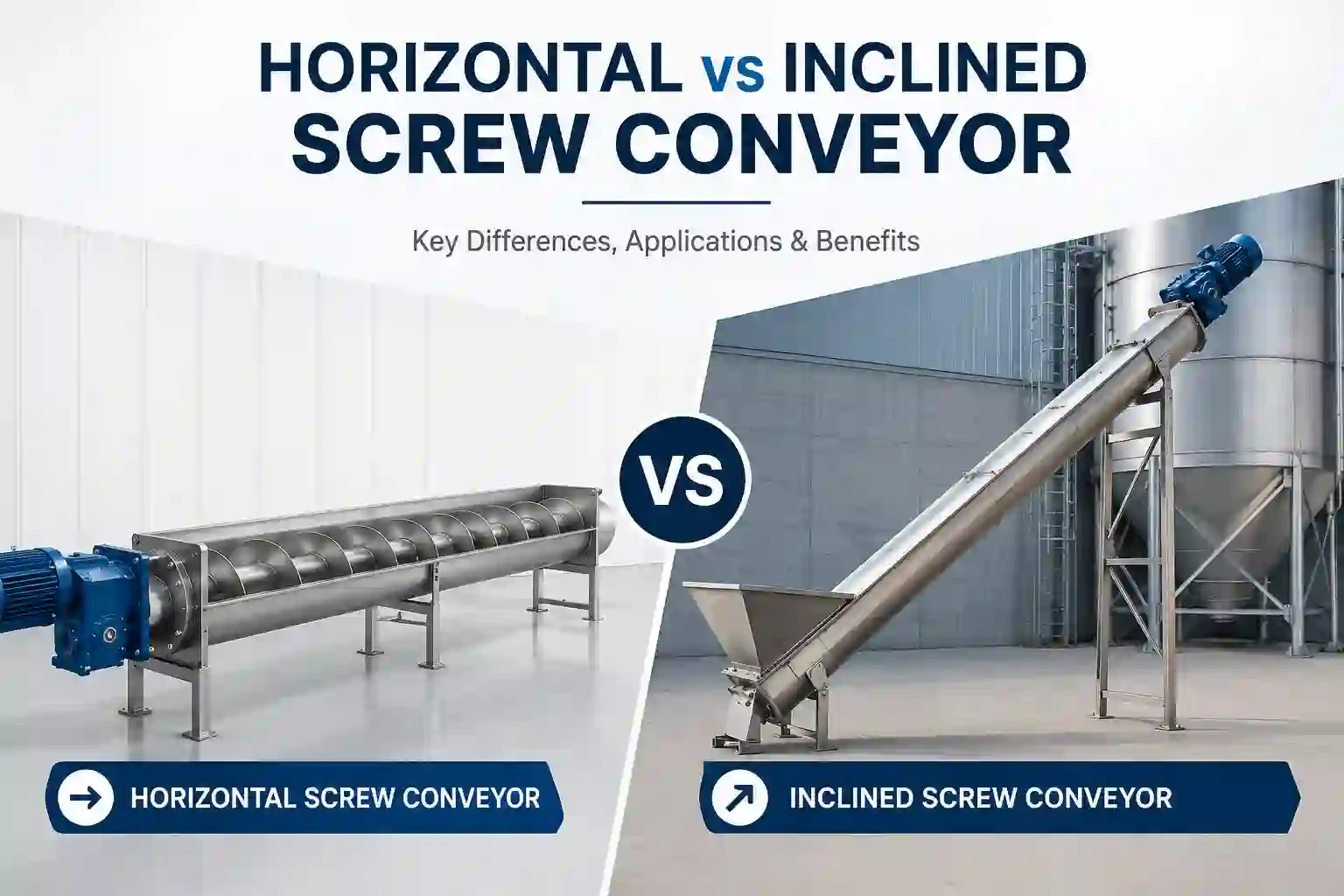
Choosing between a Horizontal vs Inclined Screw Conveyor depends on your material type, conveying distance, production capacity, and plant layout. Understanding the differences between a Horizontal vs Inclined Screw Conveyor helps manufacturers select the most efficient solution for reliable bulk material handling.
However, industries often face confusion while selecting between a Horizontal Screw Conveyor and an Inclined Screw Conveyor. Both systems are designed for bulk material handling, but their performance, efficiency, and applications vary significantly depending on production requirements.
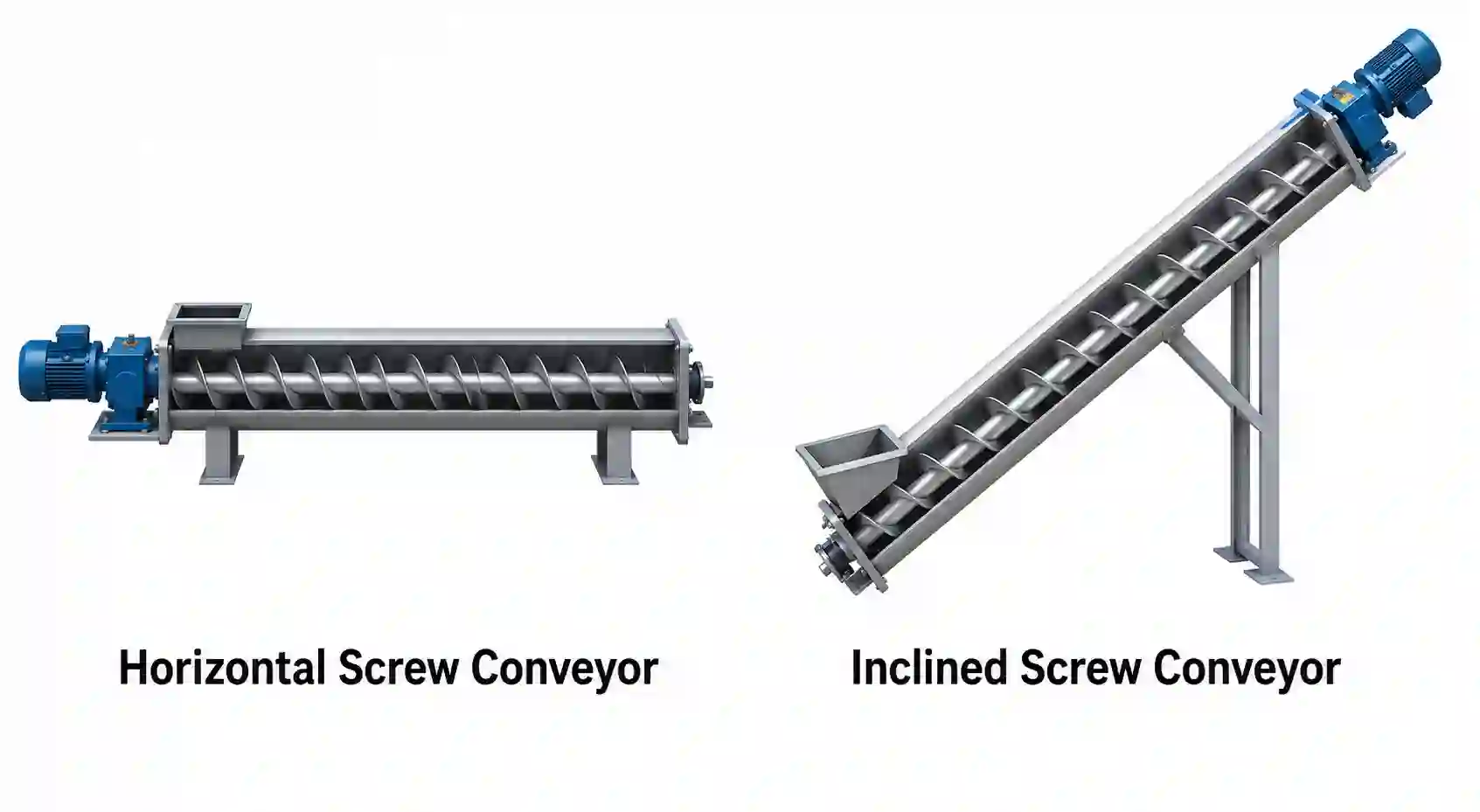
What is a Horizontal Screw Conveyor?
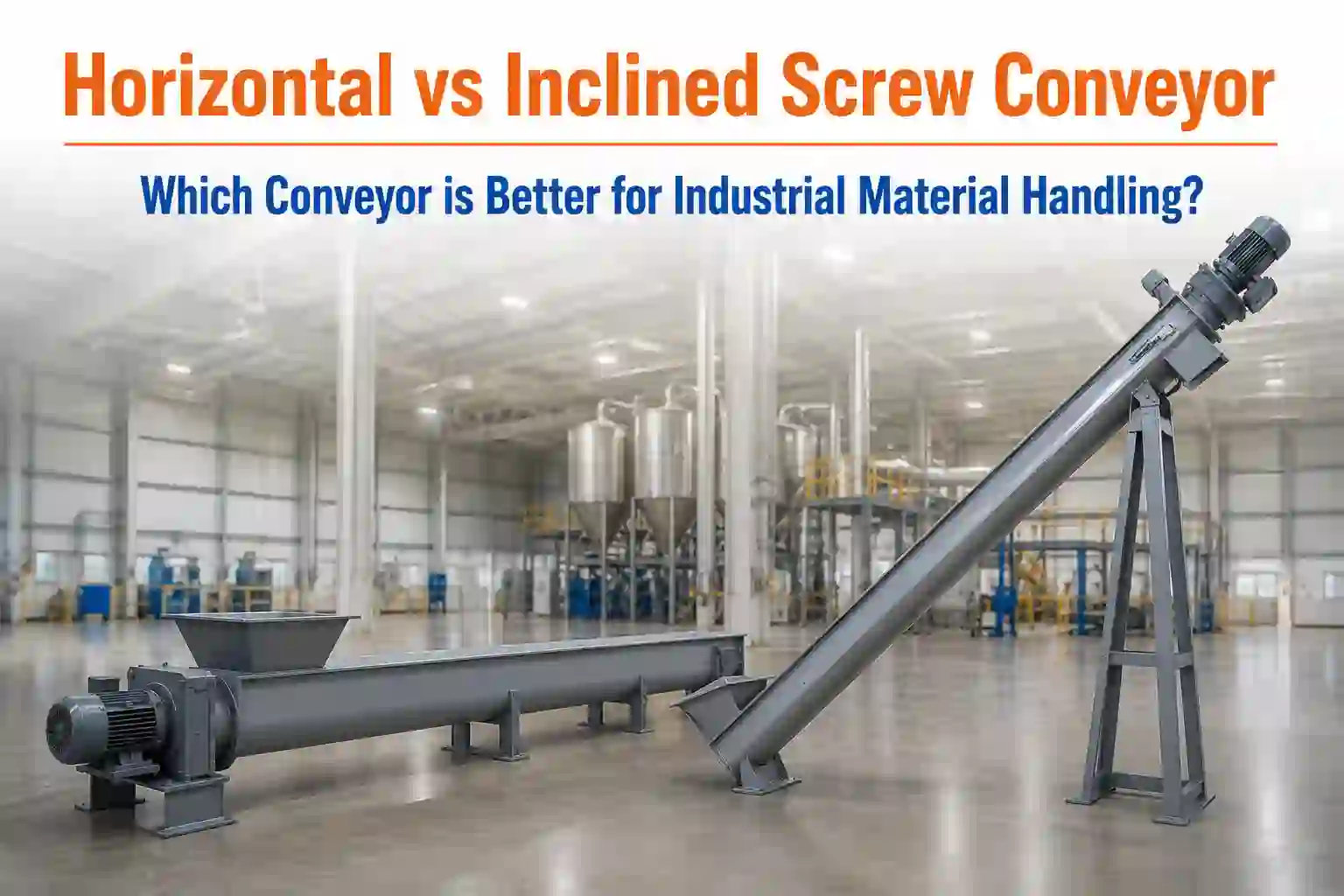
A Horizontal Screw Conveyor is designed to move materials in a straight horizontal direction using a rotating screw flight inside a trough or tubular housing.
This conveyor is commonly used for transferring powders, granules, food products, grains, spices, chemicals, and semi-solid materials over short to medium distances.
- High conveying efficiency
- Ideal for bulk materials
- Lower power consumption
- Continuous product flow
- Suitable for heavy-duty operations
What is an Inclined Screw Conveyor?
An Inclined Screw Conveyor is designed to transfer material upward at an angle. It uses a rotating screw mechanism similar to a horizontal conveyor but operates on an incline to elevate products between different processing levels.
Inclined conveyors are widely used in food processing plants, powder handling industries, snack manufacturing units, and packaging systems where vertical movement of materials is required.
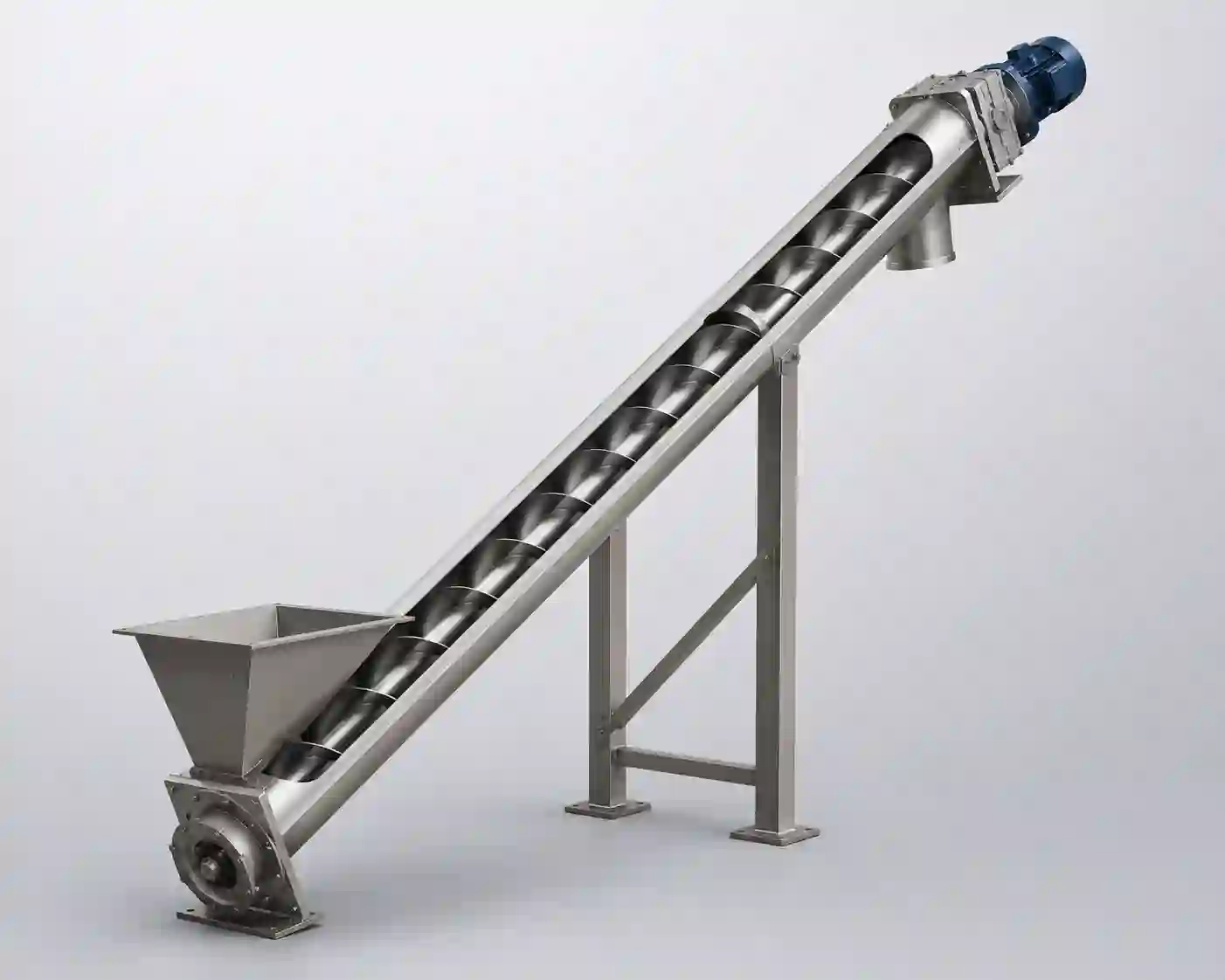
Major Differences Between Horizontal & Inclined Screw Conveyor
| Feature | Horizontal Screw Conveyor | Inclined Screw Conveyor |
|---|---|---|
| Material Direction | Horizontal Transfer | Angular / Upward Transfer |
| Efficiency | Higher | Moderate |
| Power Consumption | Lower | Higher |
| Capacity | Maximum Capacity | Reduced with Incline |
| Installation Purpose | Bulk transport | Elevating materials |
| Maintenance | Easy | Slightly higher |
Capacity & Performance Comparison
One of the biggest differences between these conveyors is conveying efficiency. Horizontal conveyors provide maximum filling efficiency because gravity supports product movement naturally inside the screw housing.
Inclined conveyors, however, experience reduced capacity as the angle increases. Higher inclinations require additional power and specialized screw designs to maintain consistent material flow.
Important Industry Insight
As conveyor inclination increases above 20 degrees, the effective conveying capacity starts decreasing. This is why proper conveyor design and screw pitch selection are extremely important.
Industrial Applications
Applications of Horizontal Screw Conveyors
- Flour mills
- Spice processing plants
- Powder handling systems
- Chemical industries
- Bulk grain transfer
- Food ingredient movement
Applications of Inclined Screw Conveyors
- Snack food processing plants
- Potato chips manufacturing
- Vertical material lifting
- Packaging systems
- Dry powder elevation
- Industrial automation lines
Common Problems & How Yuga-We100 Solves Them
| Problem | Yuga-We100 Solution |
|---|---|
| Material leakage | Precision enclosed conveyor design |
| Low conveying efficiency | Optimized screw pitch engineering |
| High maintenance | Heavy-duty industrial components |
| Product contamination | Food-grade stainless steel construction |
| Motor overloading | Efficient drive & power design |
Buying Guide – How to Choose the Right Screw Conveyor
- Identify material type and flow properties
- Evaluate required conveying angle
- Check production capacity requirements
- Select food-grade material if required
- Choose proper screw diameter and pitch
- Consider automation compatibility
- Select trusted industrial manufacturers
Industries that require simple bulk transport should choose Horizontal Screw Conveyors, while industries needing product elevation and compact layouts should prefer Inclined Screw Conveyors.
The choice between a Horizontal vs Inclined Screw Conveyor should be based on the product characteristics and the required conveying angle. Horizontal conveyors are generally preferred for maximum capacity, while inclined conveyors are ideal for lifting materials to higher processing stages.
Related Conveyor Solutions
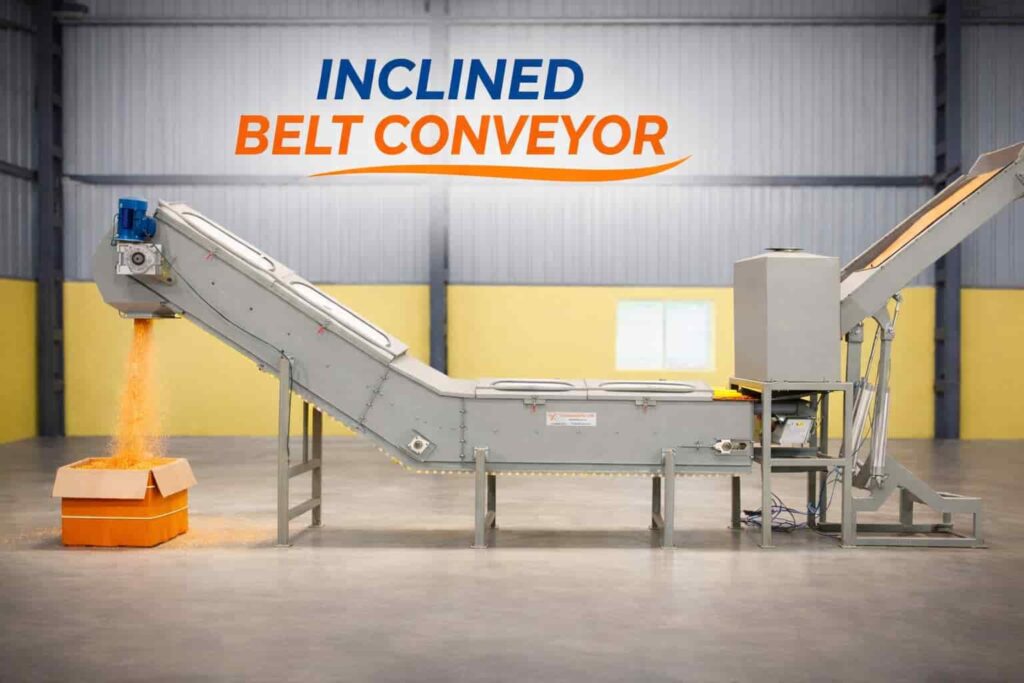
Screw Conveyor Homogeneous Inclined Belt Conveyor U Trough Belt Conveyor Distribution Conveyor Vacuum Conveyor Z Bucket Elevator Industrial Conveying SystemsWhy Choose Yuga-We100?
Yuga-We100 is a trusted manufacturer and supplier of advanced industrial conveyor systems designed for high efficiency, durability, and hygienic material handling.
Yuga-We100 designs customized Horizontal vs Inclined Screw Conveyor solutions for food processing, chemical, agricultural, and industrial applications. Our conveyors are engineered for durability, hygienic operation, and efficient material handling.
- Customized conveyor solutions
- Food-grade SS304 construction
- Industrial automation expertise
- Energy-efficient systems
- Reliable after-sales support
- Competitive pricing
Looking for Reliable Screw Conveyor Solutions?
Get customized Horizontal and Inclined Screw Conveyor systems designed for your industrial application and production requirements.
Contact Yuga-We100Learn more about screw conveyor design standards from the Conveyor Equipment Manufacturers Association (CEMA) .
Explore industrial automation and material handling best practices at MHI – Material Handling Industry .
For additional information on bulk solids handling and conveyor technologies, visit Powder & Bulk Solids .
Frequently Asked Questions
1. What is the difference between horizontal and inclined screw conveyors?
Horizontal conveyors transfer material straight, while inclined conveyors move material upward at an angle.
2. Which conveyor has higher efficiency?
Horizontal screw conveyors generally provide higher conveying efficiency.
3. Are inclined screw conveyors suitable for food industries?
Yes, food-grade inclined conveyors are widely used in snack and food processing plants.
4. Can screw conveyors handle powders?
Yes, they are ideal for powders, granules, grains, and bulk materials.
5. Which industries use screw conveyors?
Food processing, agriculture, chemicals, pharmaceuticals, and packaging industries commonly use them.
6. How do I choose the right conveyor?
Selection depends on material type, capacity, conveying angle, and production layout.
7. Does inclination affect conveyor capacity?
Yes, higher inclination angles reduce conveying efficiency and capacity.