Table of Contents
Material handling is one of the most important aspects of modern manufacturing, warehousing, logistics, mining, and food processing industries. Selecting the right conveyor system can significantly improve production efficiency, reduce labor costs, and minimize product damage. Understanding the 16 types of conveyor belts helps manufacturers make informed decisions based on product characteristics, factory layout, production capacity, and automation requirements.
Today, every modern industrial conveyor system is designed for a specific purpose. Some conveyors transport lightweight food products, while others move heavy industrial materials continuously for long production hours. Proper conveyor belt selection ensures reliable product movement, lower maintenance costs, higher productivity, and long equipment life.
Whether you operate a food processing plant, packaging unit, warehouse, pharmaceutical factory, automobile plant, or mining operation, choosing the correct conveyor is essential. A professional belt conveyor manufacturer helps design customized conveyor systems that match production requirements while supporting future expansion and automation.
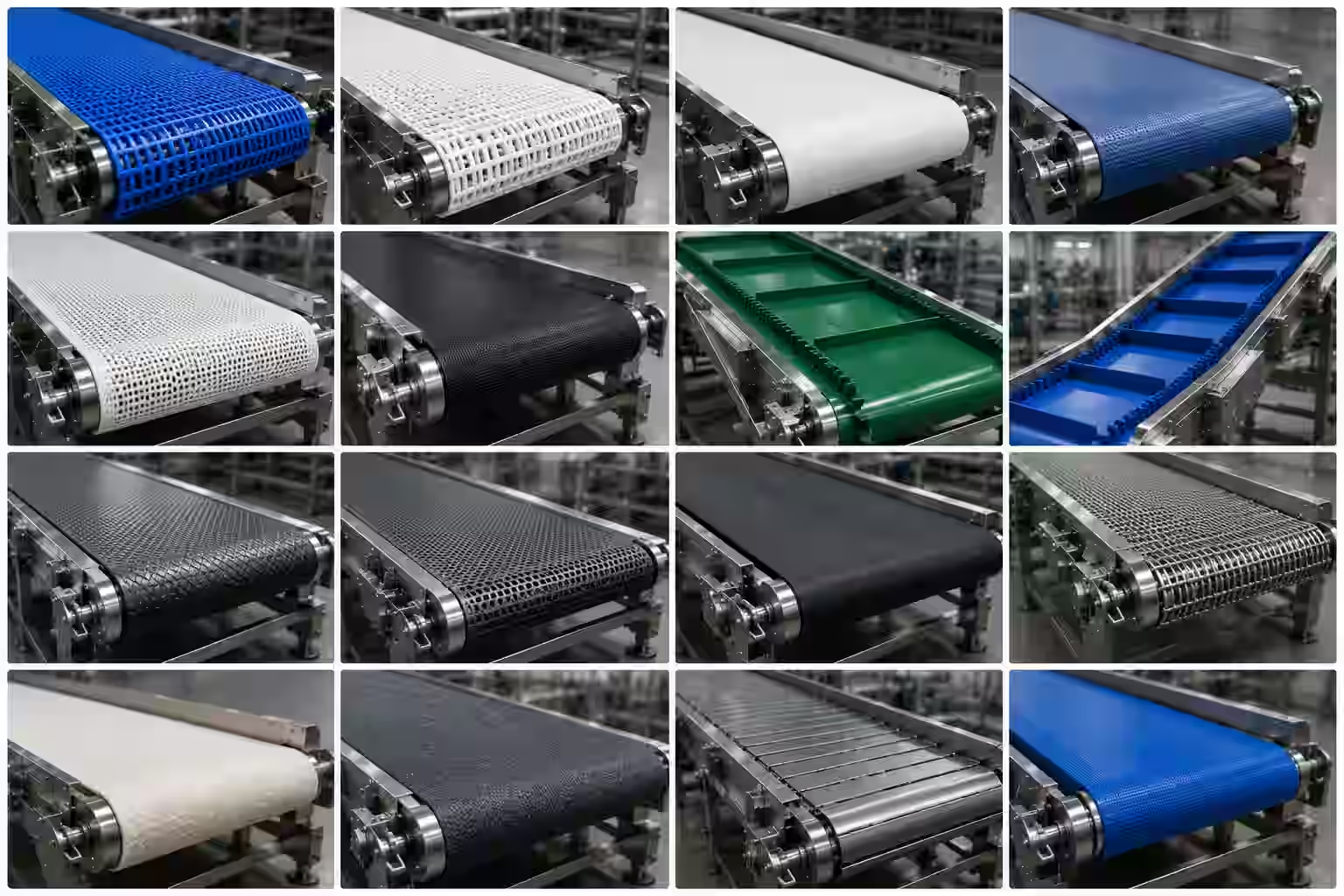
What is a Conveyor Belt?
A conveyor belt is a continuous material handling system that transports products from one location to another using an endless moving belt driven by electric motors and pulleys. Conveyor systems are widely used across manufacturing industries to automate production, improve safety, and reduce manual handling.
Modern conveyor technology has evolved significantly over the past decade. Today’s industrial conveyor system integrates PLC controls, sensors, robotic automation, vision inspection, weighing systems, and packaging equipment to create intelligent manufacturing facilities. Understanding the 16 types of conveyor belts allows businesses to select equipment that matches operational requirements and production goals.
Main Functions of Conveyor Belts
- Continuous product transportation
- Reduce manual labor
- Increase production speed
- Improve workplace safety
- Reduce product damage
- Support automated manufacturing
- Optimize factory workflow
- Lower operating costs
- Improve production efficiency
- Enhance product quality
Why Conveyor Belt Selection Matters
Proper conveyor belt selection directly affects manufacturing efficiency, maintenance costs, production capacity, and equipment reliability. Selecting the wrong conveyor can lead to unnecessary downtime, increased maintenance expenses, excessive energy consumption, and reduced product quality.
An experienced belt conveyor manufacturer evaluates multiple factors before recommending the ideal conveyor system, including product weight, product dimensions, operating environment, production speed, hygiene requirements, incline angle, available factory space, and future expansion plans.
| Incorrect Conveyor Selection | Proper Conveyor Selection |
|---|---|
| Higher maintenance cost | Long equipment life |
| Frequent breakdowns | Reliable operation |
| Reduced production efficiency | Maximum productivity |
| Higher labor requirements | Automated material handling |
| Product damage | Safe product transportation |
| Higher operating cost | Lower operational expenses |
In the following sections, we’ll explain all 16 types of conveyor belts, their advantages, applications, and how to choose the best industrial conveyor system for your industry. This guide will also simplify conveyor belt selection so you can confidently invest in the right solution from a trusted belt conveyor manufacturer.
16 Types of Conveyor Belts Explained
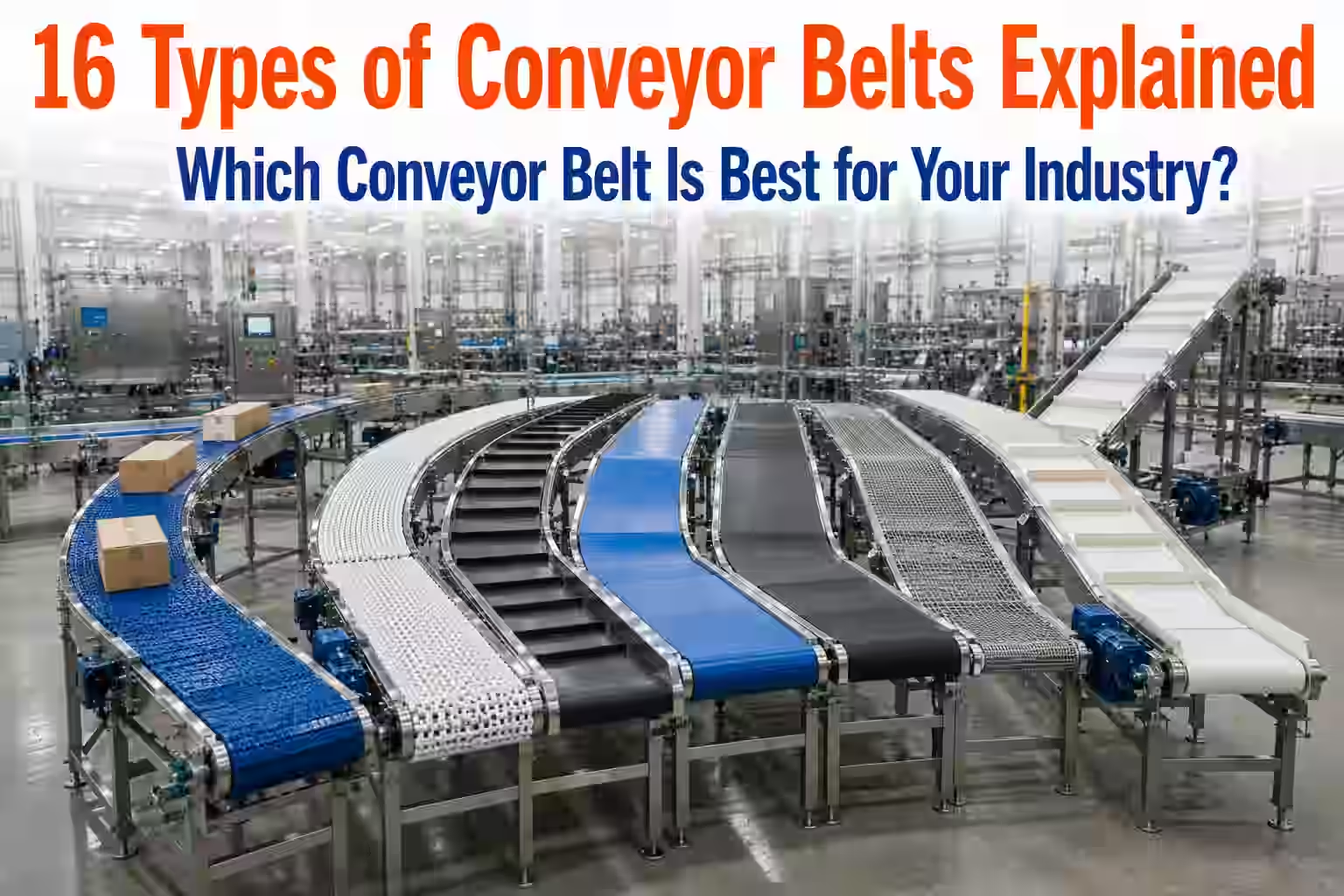
Understanding the 16 types of conveyor belts is the first step in making the right conveyor belt selection. Every conveyor belt is designed for a specific material handling task. Choosing the appropriate industrial conveyor system improves production efficiency, reduces maintenance costs, and increases equipment life. A reliable belt conveyor manufacturer can recommend the ideal conveyor based on your industry, product type, and production capacity.
| No. | Conveyor Belt Type | Best Used For |
|---|---|---|
| 1 | Flat Belt Conveyor | General material transportation |
| 2 | Inclined Belt Conveyor | Moving products to higher levels |
| 3 | Cleated Belt Conveyor | Steep angle conveying |
| 4 | Modular Plastic Belt Conveyor | Food processing & wet environments |
| 5 | Roller Bed Conveyor | Heavy cartons and pallets |
| 6 | Wire Mesh Conveyor | Baking, cooling and drying |
| 7 | PVC Belt Conveyor | Packaging industries |
| 8 | PU Food Grade Conveyor | Food manufacturing plants |
| 9 | Sidewall Belt Conveyor | Bulk material handling |
| 10 | Timing Belt Conveyor | Precision automation systems |
| 11 | Magnetic Conveyor | Metal component handling |
| 12 | Vacuum Conveyor | Lightweight products |
| 13 | Sandwich Belt Conveyor | Vertical conveying |
| 14 | Z-Type Conveyor | Food processing automation |
| 15 | Homogeneous Belt Conveyor | Hygienic food production |
| 16 | Distribution Conveyor | Multi-line product distribution |
1. Flat Belt Conveyor
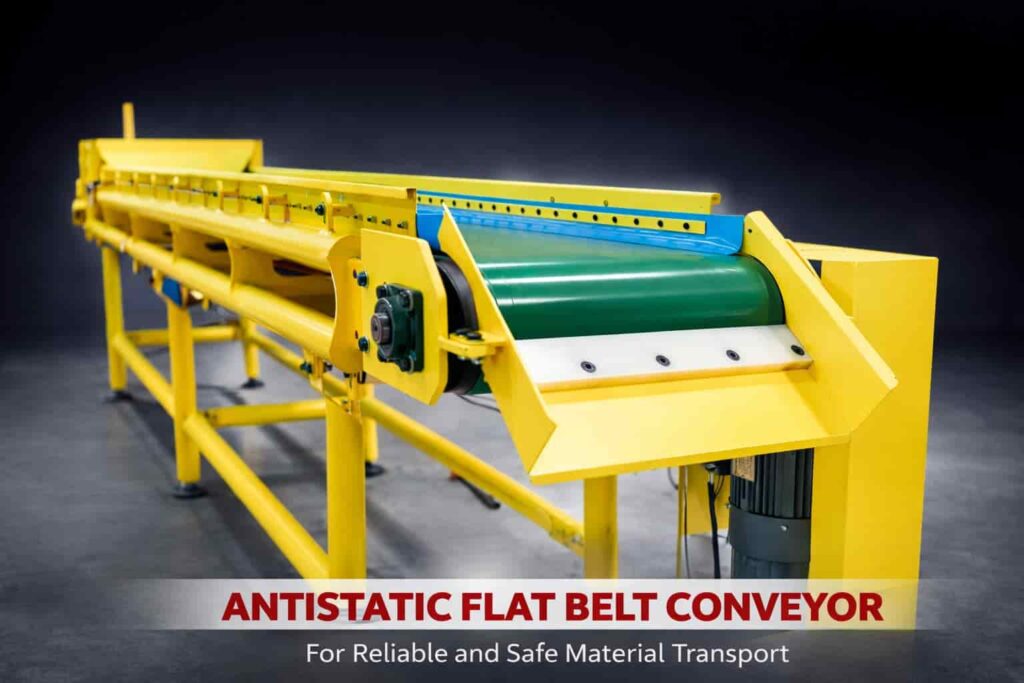
A Flat Belt Conveyor is the most commonly used conveyor in manufacturing industries. It transports products horizontally and is ideal for cartons, packaged foods, electronics, pharmaceuticals, and assembly lines. During conveyor belt selection, flat conveyors are usually the first choice because of their simplicity, affordability, and flexibility.
- Simple design
- Low maintenance
- Energy efficient
- Suitable for continuous production
- Easy installation
2. Inclined Belt Conveyor
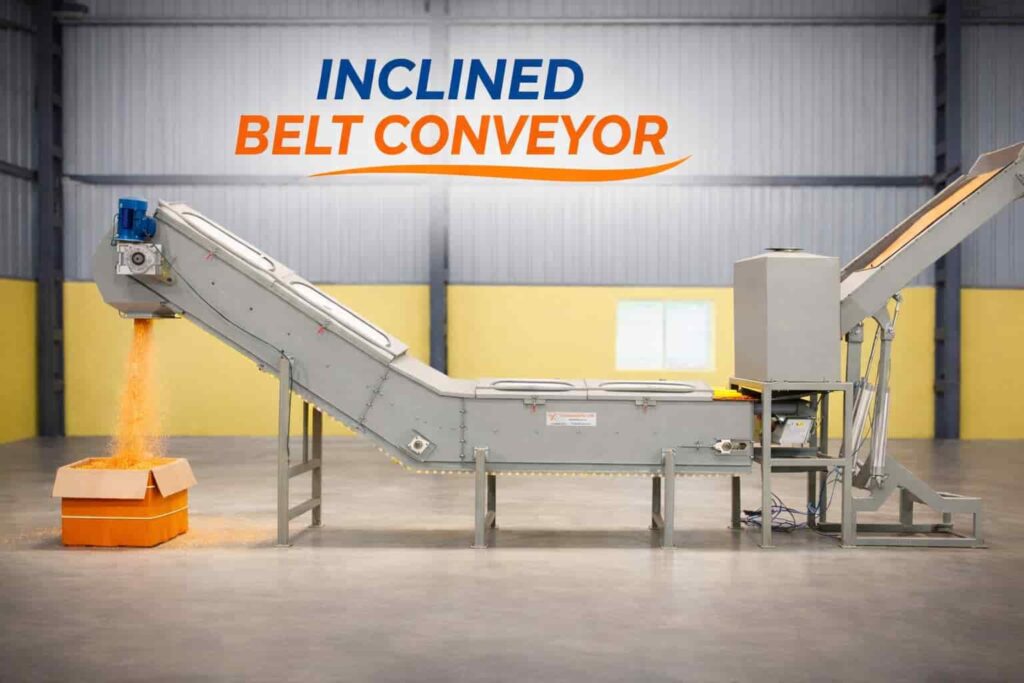
Inclined Belt Conveyors move products between different elevations. They are widely used in snack manufacturing, potato processing, warehouses, and packaging plants. A professional belt conveyor manufacturer can customize the conveyor angle according to production requirements.
- Moves products upward safely
- Space-saving design
- High load capacity
- Ideal for automation
- Available with cleats
3. Cleated Belt Conveyor
Cleated conveyors use raised cleats attached to the belt surface to prevent materials from slipping while moving on steep inclines. These conveyors are commonly used for transporting vegetables, fruits, grains, powders, and industrial components.
Advantages
- Excellent grip
- Handles loose materials
- Reduces product rollback
- Ideal for inclined conveying
- Improves production efficiency
4. Modular Plastic Belt Conveyor
A Modular Plastic Belt Conveyor consists of interlocking plastic modules that provide excellent durability and hygiene. It is one of the most popular options in food manufacturing because individual belt sections can be replaced without changing the entire belt.
- Easy cleaning
- Food-grade construction
- Excellent drainage
- Easy repairs
- Long service life
5. Roller Bed Conveyor
Roller Bed Conveyors use rollers beneath the conveyor belt to reduce friction and support heavy loads. They are commonly used in logistics centers, warehouses, airports, and packaging industries where large cartons and pallets need to be transported efficiently.
- Heavy-duty operation
- Low rolling resistance
- Reduced motor load
- Suitable for long conveyor lengths
- Excellent durability
6. Wire Mesh Conveyor
Wire Mesh Conveyors are manufactured using stainless steel mesh belts and are widely used in baking, cooling, frying, freezing, washing, and drying applications. These systems allow excellent airflow around products and are ideal for high-temperature environments.
The remaining conveyor belt types (7 to 16) will cover PVC Belt Conveyor, PU Food Grade Conveyor, Sidewall Belt Conveyor, Timing Belt Conveyor, Magnetic Conveyor, Vacuum Conveyor, Sandwich Belt Conveyor, Z-Type Conveyor, Homogeneous Belt Conveyor, and Distribution Conveyor, along with industry applications and selection guidelines.
7. PVC Belt Conveyor
A PVC Belt Conveyor is one of the most economical and widely used solutions among the 16 types of conveyor belts. PVC belts are lightweight, durable, and suitable for transporting cartons, packaged products, plastic components, and lightweight industrial materials. During conveyor belt selection, PVC conveyors are preferred for dry production environments due to their excellent wear resistance and low maintenance requirements.
- Affordable solution
- Lightweight construction
- Easy maintenance
- Smooth product movement
- Suitable for packaging industries
8. PU Food Grade Conveyor Belt
A PU Food Grade Conveyor Belt is specially designed for hygienic food handling. Manufactured using food-safe polyurethane materials, it is ideal for direct food contact and widely used in bakeries, dairy plants, meat processing, snack manufacturing, fruit processing, and frozen food production. Every experienced belt conveyor manufacturer recommends PU belts where hygiene and food safety are critical.
Advantages
- FDA-approved food-safe material
- Oil and grease resistant
- Easy to sanitize
- Excellent wear resistance
- Long operational life
9. Sidewall Belt Conveyor
Sidewall Belt Conveyors transport bulk materials at steep angles using flexible corrugated sidewalls. They are commonly used in mining, cement plants, fertilizer manufacturing, grain handling, and recycling facilities where materials must be lifted vertically without spillage.
- High-angle conveying
- Prevents material spillage
- Space-saving installation
- Suitable for bulk handling
- Heavy-duty operation
10. Timing Belt Conveyor
Timing Belt Conveyors are designed for precision product positioning. Their toothed belts synchronize movement accurately, making them ideal for robotics, electronics, automation systems, pharmaceutical production, and assembly lines where exact positioning is required.
- Accurate positioning
- Slip-free movement
- Excellent synchronization
- High-speed automation
- Reliable precision handling
11. Magnetic Conveyor
Magnetic Conveyors use powerful permanent magnets or electromagnets to move ferrous components safely without slipping. These conveyors are widely used in automobile manufacturing, metal fabrication, machining centers, and recycling plants.
- Secure metal transportation
- Ideal for machining operations
- Minimal product movement
- Reduced handling damage
- Continuous operation
12. Vacuum Conveyor
Vacuum Conveyors transport lightweight products by creating controlled suction beneath the belt. They are frequently used for paper products, flexible packaging, films, labels, printed materials, and lightweight food packaging where precise positioning is essential.
| Conveyor Type | Main Industry | Key Benefit |
|---|---|---|
| PVC Belt Conveyor | Packaging | Economical solution |
| PU Food Grade Belt | Food Processing | Hygienic operation |
| Sidewall Conveyor | Mining | Steep angle conveying |
| Timing Belt Conveyor | Automation | Precise positioning |
| Magnetic Conveyor | Metal Industry | Safe metal handling |
| Vacuum Conveyor | Packaging | Lightweight products |
13. Sandwich Belt Conveyor
Sandwich Belt Conveyors use two conveyor belts to securely grip products while transporting them vertically or on steep inclines. They are suitable for mining, aggregates, cement plants, and bulk material handling applications requiring high-capacity lifting.
14. Z-Type Conveyor
Z-Type Conveyors are among the most popular solutions in food manufacturing. Their bucket-style design transports products vertically without damage, making them ideal for potato chips, namkeen, frozen foods, dry fruits, pulses, snacks, and bakery products. During conveyor belt selection, Z-Type systems are often chosen because they save floor space and integrate easily into automated production lines.
15. Homogeneous Belt Conveyor
Homogeneous Belt Conveyors feature a single-piece belt without joints or fabric layers, providing maximum hygiene and easy cleaning. They are commonly installed in dairy, meat, seafood, bakery, and pharmaceutical manufacturing where contamination risks must be minimized.
16. Distribution Conveyor
Distribution Conveyors automatically divert products to multiple production lines or packaging stations. Modern industrial conveyor system designs integrate distribution conveyors with PLC controls, sensors, robotic systems, and packaging equipment to improve production flexibility and maximize throughput.
Common Conveyor Belt Materials
Choosing the correct belt material is equally important as selecting among the 16 types of conveyor belts. Different materials provide varying levels of durability, flexibility, hygiene, and chemical resistance depending on the application.
| Belt Material | Best Application |
|---|---|
| PVC | Packaging & Warehousing |
| PU | Food Processing |
| Rubber | Heavy Industrial Plants |
| Modular Plastic | Food & Beverage |
| Wire Mesh | Baking & Cooling |
| Stainless Steel | High Hygiene Applications |
Industrial Applications of Conveyor Belts
The 16 types of conveyor belts are designed to serve a wide range of industries, from food processing and pharmaceuticals to mining and automotive manufacturing. Choosing the correct industrial conveyor system improves production efficiency, minimizes downtime, and ensures safe product handling. Proper conveyor belt selection also helps businesses optimize material flow while reducing operational costs.
| Industry | Recommended Conveyor Belt |
|---|---|
| Food Processing | PU Food Grade Conveyor, Homogeneous Belt Conveyor |
| Potato Chips Manufacturing | Z-Type Conveyor, Inclined Belt Conveyor |
| Namkeen Production | Food Grade Belt Conveyor |
| Bakery Industry | Wire Mesh Conveyor, PU Conveyor |
| Dairy Industry | Food Grade Conveyor Belt |
| Warehouse & Logistics | Roller Bed Conveyor, Flat Belt Conveyor |
| Mining Industry | Rubber Belt Conveyor, Sidewall Conveyor |
| Automobile Industry | Magnetic Conveyor, Timing Belt Conveyor |
| Packaging Industry | PVC Belt Conveyor, Vacuum Conveyor |
| Pharmaceutical Industry | PU Belt Conveyor |
Comparison of the 16 Types of Conveyor Belts
| Conveyor Type | Best Feature | Industry |
|---|---|---|
| Flat Belt | General conveying | All Industries |
| Inclined Belt | Vertical transportation | Food & Packaging |
| Cleated Belt | Prevents rollback | Agriculture |
| Modular Plastic | Easy cleaning | Food Processing |
| Roller Bed | Heavy loads | Warehousing |
| Wire Mesh | Heat resistant | Bakery |
| PVC Belt | Economical | Packaging |
| PU Belt | Food safe | Food Industry |
| Sidewall Belt | Steep incline | Mining |
| Timing Belt | High precision | Automation |
| Magnetic Conveyor | Metal transport | Automobile |
| Vacuum Conveyor | Lightweight handling | Packaging |
| Sandwich Belt | Vertical conveying | Bulk Material |
| Z-Type Conveyor | Space saving | Food Processing |
| Homogeneous Belt | Maximum hygiene | Dairy & Meat |
| Distribution Conveyor | Product routing | Packaging Lines |
How to Select the Right Conveyor Belt
Proper conveyor belt selection is essential for maximizing productivity and reducing maintenance costs. An experienced belt conveyor manufacturer evaluates production requirements before recommending the best industrial conveyor system. Understanding the 16 types of conveyor belts helps businesses choose equipment that matches their operational needs.
Selection Checklist
- Identify product size and weight.
- Determine production capacity.
- Select the correct belt material.
- Consider operating temperature.
- Evaluate hygiene requirements.
- Check conveyor speed requirements.
- Plan future production expansion.
- Ensure compatibility with automation.
- Calculate maintenance requirements.
- Select a trusted belt conveyor manufacturer.
Maintenance Tips
- Inspect belts every day.
- Maintain proper belt alignment.
- Lubricate bearings regularly.
- Clean food-grade conveyors after every shift.
- Replace worn rollers immediately.
- Inspect motors and gearboxes monthly.
- Check safety sensors.
- Monitor conveyor speed.
- Perform preventive maintenance.
- Train operators properly.
Related Conveyor Solutions
Horizontal Flat Belt ConveyorInclined Belt ConveyorHomogeneous Inclined Belt ConveyorDistribution ConveyorZ Type ConveyorVacuum ConveyorVibrating ConveyorFood Processing Automation SystemNeed Help Choosing the Right Conveyor Belt?
Yuga-We100 is a trusted belt conveyor manufacturer offering customized industrial conveyor system solutions. Our experts help you compare the 16 types of conveyor belts, simplify conveyor belt selection, and deliver reliable automation solutions for food processing, manufacturing, warehousing, and industrial applications.
Get Free ConsultationSelecting the right conveyor system is a critical investment that directly impacts productivity, operational costs, product quality, and factory efficiency. Understanding the 16 types of conveyor belts allows manufacturers to make informed decisions based on production requirements, material characteristics, hygiene standards, and future automation goals.
From Flat Belt Conveyors and Inclined Conveyors to Z-Type Conveyors, Homogeneous Belts, and Distribution Conveyors, every industrial conveyor system has its own advantages. Proper conveyor belt selection ensures smooth product flow, minimizes downtime, reduces maintenance costs, and supports continuous production.
As a leading belt conveyor manufacturer, Yuga-We100 provides customized conveyor solutions for food processing, snacks manufacturing, packaging, pharmaceuticals, warehousing, and industrial automation. Our engineering team designs reliable conveyor systems that improve production efficiency while complying with international food safety and industrial standards.